
- Home
- THE CRITICAL ROLE OF FREQUENCY MEASUREMENT IN RADAR ACCURACY
THE CRITICAL ROLE OF FREQUENCY MEASUREMENT IN RADAR ACCURACY
THE CRITICAL ROLE OF FREQUENCY MEASUREMENT IN RADAR ACCURACY
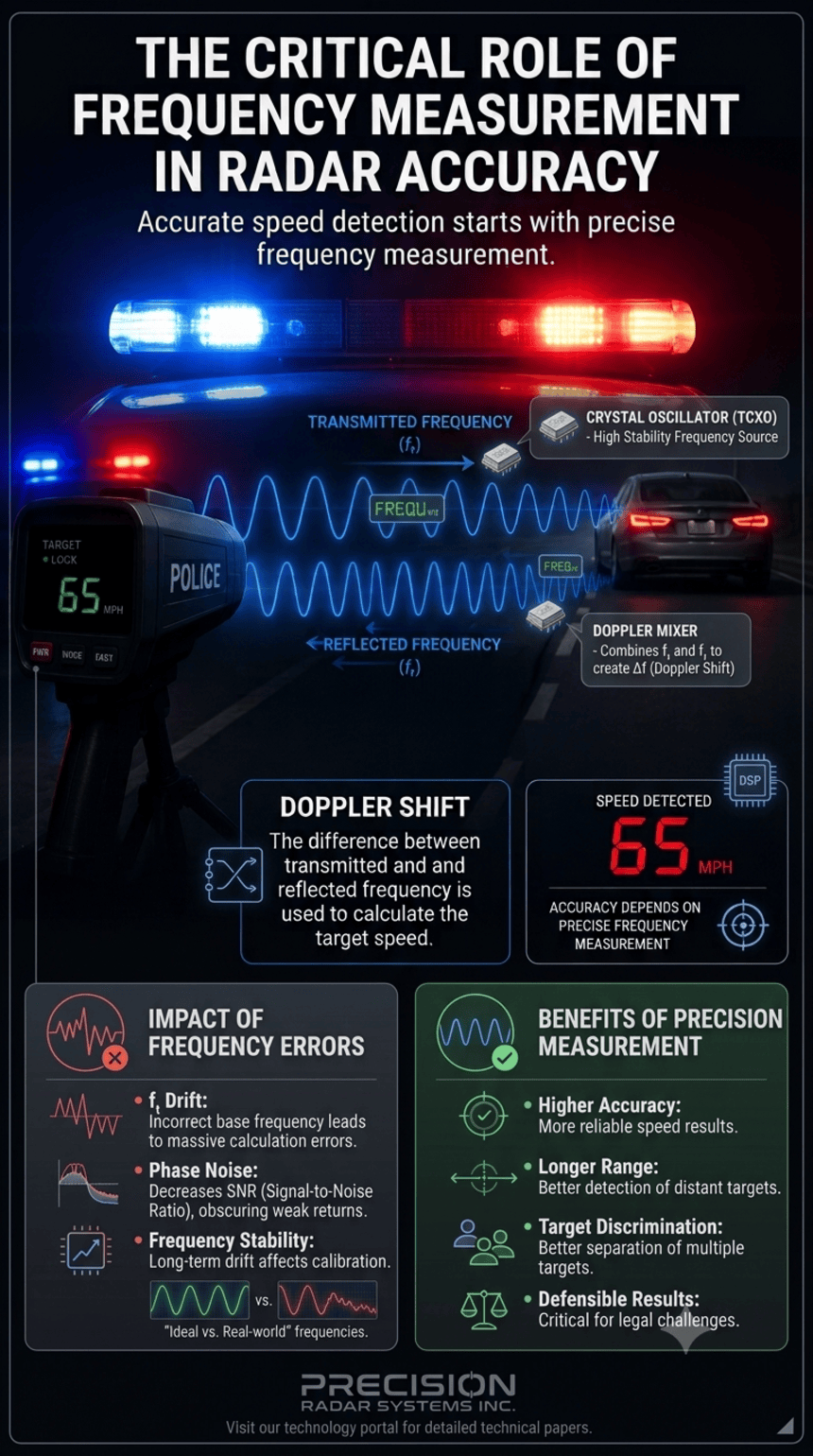
The National Institute of Standards and Technology, National Highway Traffic Safety Administration, and International Chiefs of Police, all agree, the most critical aspect of radar certification is its actual operating frequency measurement.
Why Frequency Matters
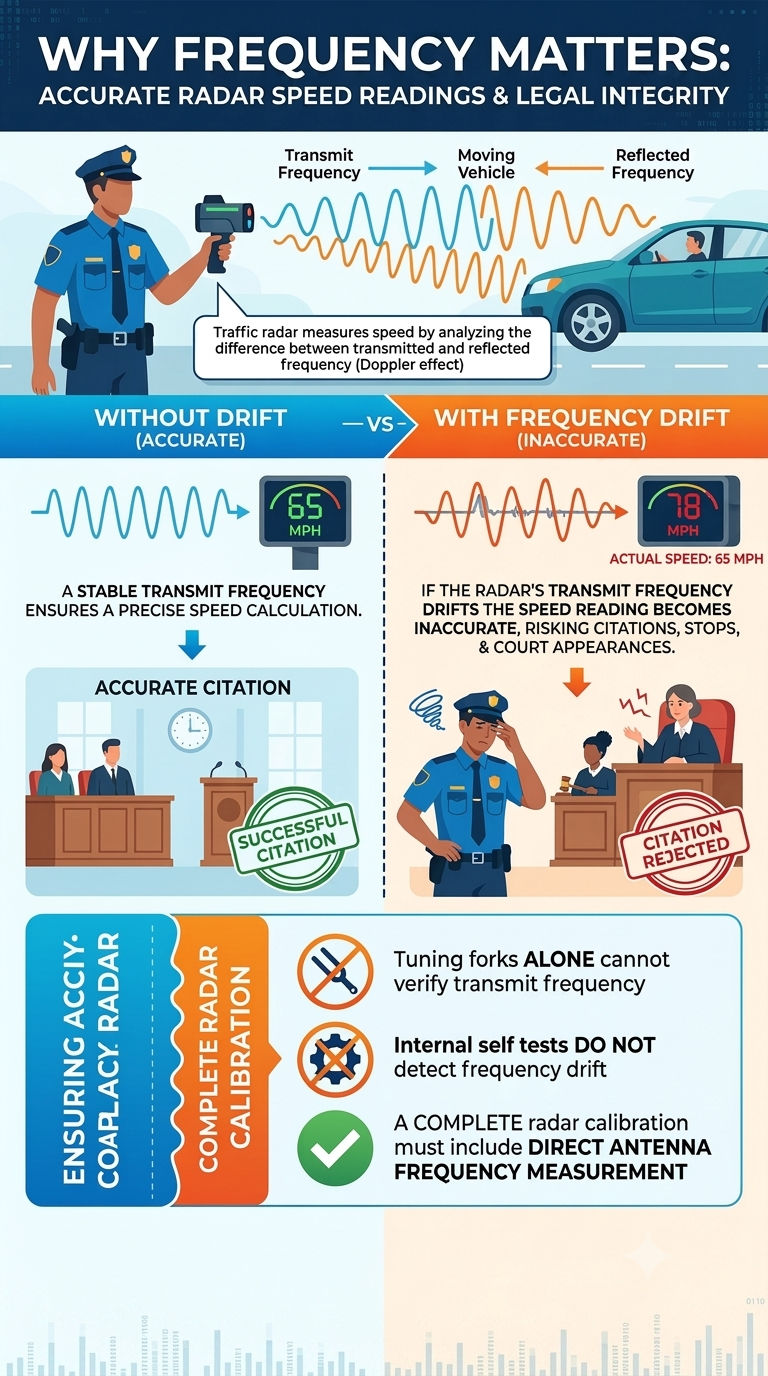
Traffic radar determines speed by measuring the change in frequency of the radar signal reflected from a moving vehicle.
If the radar’s transmit frequency drifts the speed reading can become inaccurate and that puts every citation, every stop, and every courtroom appearance at risk.
A complete radar calibration must include direct antenna frequency measurement using NIST traceable equipment.
- Tuning forks alone cannot verify transmit frequency
- Internal self tests do not detect frequency drift
- Only certified frequency measurement confirms the radar is performing as designed
How to Tell if Your Radar’s Frequency Was Actually Measured
Check Your Certificate of Accuracy
Look for a specific entry like: Transmitter Frequency: Antenna 1 ______ GHz
If this field is blank or shows one of the numbers below, the frequency was not measured.
- 24.15 GHz – All K Band
- 33.8 GHz – MPH
- 34.7 GHz – Stalker
- 35.5 GHz – Kustom
These are FCC assigned center frequencies for each radar band.
They do not reflect your unit’s actual transmit frequency. If your certificate only lists the center frequency, it’s not defensible. Only a measured frequency proves your radar is operating accurately.
Choose a certification company that performs true frequency measurement—not shortcuts.
Accuracy isn’t optional. It’s your credibility.
TR&LS: Frequency meters are expensive—and we use them. You can watch your radar’s frequency measurement in real time as our technician checks it directly from your unit. This is one of the reasons legitimate certifications cost more.
Latest Radar Certification Scams
A number of less than reputable radar and Lidar certification companies have recently emerged, attempting to capitalize on the trust of law enforcement agencies. These companies often charge significantly lower prices than legitimate providers for “certifying” Doppler radar devices and/or Lidar units in order to win your business.
Is a low priced certification legitimate? It can be—but the points below will help you make that determination while also explaining why a legitimate certification from The Radar & Laser Shop (TR&LS) may cost a few dollars more. Ultimately, it is the department’s responsibility to protect its reputation and its community from inferior services.
1. Technician Training
Today’s radars are highly sophisticated. What training have these companies’ technicians actually received? All too often, the answer is: “I’ve been doing it for a while now,” with no formal training. Defense attorneys love this—because it’s easy to corner someone into admitting, “I could be doing it wrong this whole time, but I don’t really know.”
TR&LS: Our technicians complete a six month training program covering all makes and models of Doppler radar. They must then perform 200 certifications under the supervision of an FCC licensed technician.
2. Court Defensibility
What is their policy for defending their certificates in court? When was the last time they actually appeared in a case?
Many departments are surprised to learn that when a certificate from one of these low cost providers is finally challenged, the company simply doesn’t show up—because they know their certificate cannot withstand knowledgeable scrutiny. Unfortunately, it’s often the critical case you cannot afford to lose that ends up being challenged.
TR&LS: Our certifications are so defensible that we appear in court at no cost to our clients. In 35 years of business, our certifications have never been defeated in court.
3. Certification Equipment
What equipment do they use for radar certification? It must be traceable to the National Institute of Standards and Technology (NIST) when presented in court. Ask whether they can prove their equipment is calibrated to those standards. Most cannot.
TR&LS: All equipment used in our radar certifications is calibrated annually to NIST specifications. Documentation is available upon request.
4. Transmitter Frequency Measurement (Critical)
The IACP, NHTSA, and NIST have explicitly stated:
Without accurate measurement of a radar device’s transmitter frequency, the device is not certified.
TR&LS: Frequency meters are expensive—and we use them. You can watch your radar’s frequency measurement in real time as our technician checks it directly from your unit. This is one of the reasons legitimate certifications cost more.